

JSW Energy Share Price Target 2025: Projected to reach ₹850-₹900 driven by renewable energy expansion (60% capacity by 2025), strong financials, and bullish stock indicators.
Table of Contents
- Company Overview: The Green Shift
- Financial Performance: Strong Growth
- Technical Analysis: A Bullish Long-Term Trend
- Sector Overview: India’s Power Market Outlook
- SWOT Analysis: JSW Energy
- JSW Energy Share Price Target for 2025
- Conclusion: A Long-Term Investment Opportunity
- Frequently Asked Questions (FAQs) about JSW Energy Stock
1. Company Overview: The Green Shift
JSW Energy operates a diversified portfolio of thermal, wind, hydro, and solar energy projects, aiming to have 60% of its capacity sourced from renewables by 2025. The company’s current assets (FY24) include:
- Thermal Capacity: 3,858 MW (700 MW under construction)
- Renewable Capacity: 5,922 MW (2,321 MW under construction)
- Wind Energy: 3,628 MW
- Hydro Energy: 1,631 MW
- Solar Energy: 675 MW
JSW Energy intends to double its capacity by 2030. The company also aims to reduce its carbon footprint by 50% in the same period. This plan reinforces its commitment to sustainability.
2. Financial Performance: Strong Growth in Q1 FY25
JSW Energy has demonstrated robust growth, as shown in the table below. The company’s EBITDA margin surged to 52% in Q1 FY25, reflecting operational efficiency, particularly in the renewable sector.
| Metrics | Q1 FY25 | Q1 FY24 |
|---|---|---|
| Revenue | ₹3,043 Cr | ₹3,013 Cr |
| EBITDA | ₹1,581 Cr | ₹1,307 Cr |
| Profit After Tax (PAT) | ₹522 Cr | ₹290 Cr |
| Cash PAT | ₹958 Cr | ₹743 Cr |
| EBITDA Margin (%) | 52% | 43% |
The company has invested significantly in expanding its renewable assets. It has a planned capital expenditure (CapEx) of ₹19,360 Cr. ₹11,317 Cr of this amount has already been utilized. These investments are expected to drive revenue growth and improve margins in the coming years.
3. Technical Analysis: A Bullish Long-Term Trend
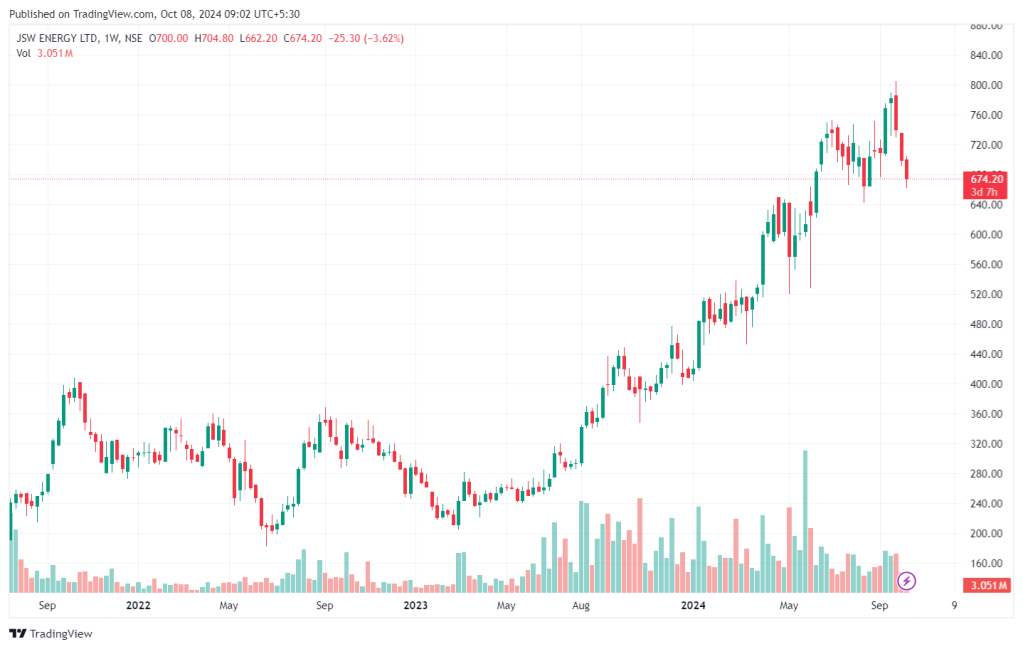
JSW Energy’s stock has maintained a strong upward trajectory since mid-2023, after breaking out from its consolidation phase. Below is a summary of key technical observations:
- Support Levels: ₹620 and ₹580 (strong buying interest)
- Resistance Levels: ₹805 (52-week high)
- Current Price (October 2024): ₹674
The stock is making higher highs and higher lows, a bullish pattern that indicates long-term growth potential. Here’s a closer look at the technical indicators:
- RSI: Slightly overbought, indicating that the recent correction was healthy.
- MACD: Positive, with a bullish crossover on the horizon, signaling potential upward momentum.
4. Sector Overview: India’s Power Market Outlook
India’s power sector is evolving rapidly. It is driven by an increasing demand for clean energy. Government mandates promote renewable capacity expansion. As of May 2024, peak power demand reached record levels. It hit 250 GW. This reflects the growing consumption needs of the nation.
- Renewable Energy Push: The government aims to add 30-35 GW of renewable capacity by FY25.
- Thermal Power Decline: Regulatory pressures and carbon emission concerns have reduced the appeal of coal-based power. This makes renewable energy more attractive for long-term growth.
JSW Energy is committed to expanding its renewable capacity. This commitment aligns perfectly with these trends. It positions the company to capitalize on the sector’s growth.
5. SWOT Analysis: JSW Energy
| Strengths | Weaknesses |
|---|---|
| Diversified portfolio (thermal, wind, hydro) | Continued reliance on thermal energy |
| Strong financial performance (EBITDA 52%) | Delays in renewable project commissioning |
| Low debt-to-equity ratio | |
| Opportunities | Threats |
| Growing demand for clean energy | Regulatory risks impacting thermal power |
| Expansion into global renewable markets | Rising competition in the renewable sector |
6. JSW Energy Share Price Target for 2025
Based on both technical and fundamental analyses, JSW Energy’s stock has significant growth potential. Factors contributing to its upside include:
- Completion of SECI-IX Wind Projects, adding 2.1 GW by 2025.
- Increasing the share of renewables to 60% of the total capacity.
- Strong EBITDA growth driven by higher capacity utilization and favorable PPA terms.
The projected price target for JSW Energy in 2025 is:
| Year | Expected Price Range |
|---|---|
| 2025 | ₹850 – ₹900 |
7. Conclusion: A Long-Term Investment Opportunity
JSW Energy is undergoing a major transformation, moving towards renewable energy and reducing its reliance on thermal power. With its solid financial performance, low debt levels, and aggressive CapEx plans, the stock is poised for strong growth. Investors are advised to buy on dips around the support levels of ₹620-₹580 for maximum gains by 2025.
Investment Strategy Tip: Consider long-term investment to benefit from the global shift towards green energy, as the stock’s long-term potential remains bullish.
Disclaimer: This article is based on research and public data. Investors should consult with a SEBI-registered financial advisor before making investment decisions.
Frequently asked questions (FAQs) about JSW Energy stock
1. Why is JSW Energy share price falling?
JSW Energy’s share price may fall due to several factors, including market-wide corrections, profit-booking after a significant rally, or sector-specific issues like regulatory changes in the energy market. Additionally, if the company faces delays in renewable energy projects or posts earnings below market expectations, it could trigger a short-term decline in stock price.
2. Is JSW Energy a good stock for long-term investment?
Yes, JSW Energy is considered a good stock for long-term investment due to its strategic focus on expanding renewable energy capacity. With aggressive plans to increase its green energy portfolio and its solid financial position, the company is well-positioned to benefit from the growing demand for clean energy in India and abroad.
3. What is the JSW Energy share price target for 2025?
Based on current technical and fundamental analysis, the JSW Energy share price target for 2025 is projected to be between ₹850 to ₹900. This forecast takes into account the company’s strong growth potential in renewable energy, its financial health, and sectoral tailwinds from the government’s push toward green energy.
4. What are the support and resistance levels for JSW Energy stock?
As of 2024, key support levels for JSW Energy stock are around ₹620 and ₹580, while the resistance levels are at ₹805, which is the stock’s 52-week high. These levels can be useful for traders looking to time their entries and exits.
5. Why is JSW Energy focusing on renewable energy?
JSW Energy is focusing on renewable energy to align with global trends and India’s energy policy, which is increasingly emphasizing clean energy. The company aims to reduce its carbon footprint by 50% by 2030 and increase its renewable capacity to 60% by 2025. This shift will also help JSW Energy improve its margins and ensure long-term sustainable growth.
6. What is the future outlook for JSW Energy stock?
The future outlook for JSW Energy is positive due to its ongoing transition to renewable energy, solid financial performance, and aggressive expansion plans. The company’s low debt levels and strong operational performance further enhance its growth prospects. Analysts expect the stock to perform well in the long term, with price targets ranging from ₹850 to ₹900 for 2025.
7. What are the risks of investing in JSW Energy stock?
Some of the key risks associated with investing in JSW Energy include regulatory risks related to its thermal power plants, delays in renewable project execution, and potential increases in equipment costs for solar and wind energy projects. Additionally, rising competition in the renewable energy sector could impact the company’s profit margins.
8. What is the current dividend yield of JSW Energy?
As of 2024, JSW Energy has been maintaining a healthy dividend payout. However, investors are encouraged to check the latest financial reports or company announcements to find the most up-to-date dividend yield figures.
9. When is the best time to buy JSW Energy shares?
The best time to buy JSW Energy shares could be around its support levels, which are currently at ₹620 and ₹580. Investors looking for long-term gains may consider buying on dips, especially when the stock shows strong buyer interest around these levels, while keeping an eye on market trends and company updates.
10. How is JSW Energy performing in renewable energy projects?
JSW Energy is performing well in the renewable energy sector, with 61% of its current portfolio coming from wind energy. The company aims to increase its renewable capacity to 60% of its total energy output by 2025, driven by ongoing projects in wind, solar, and hydro power. This strategic shift is expected to enhance revenue and improve margins in the future.
11. What factors are driving JSW Energy’s stock price?
JSW Energy’s stock price is primarily driven by its aggressive expansion into renewable energy, strong financial performance, and increasing demand for clean energy in India. Positive earnings reports, completion of key renewable projects, and favorable government policies supporting green energy are some of the factors contributing to its bullish price trend.
12. Is JSW Energy stock overvalued or undervalued?
As of 2024, JSW Energy is trading within a range that reflects its growth potential in the renewable energy sector. The stock is neither significantly overvalued nor undervalued, according to market analysts. Its strong financial performance and future growth prospects suggest that it still holds potential for appreciation, especially if it can continue executing its renewable projects efficiently.
13. What is JSW Energy’s strategy for reducing carbon emissions?
JSW Energy has set an ambitious goal to reduce its carbon emissions by 50% by 2030. The company is executing this strategy by increasing its investment in renewable energy projects, such as wind, solar, and hydro power, and transitioning away from thermal power. This shift is part of its long-term vision to become a major player in the global clean energy space.
14. How does JSW Energy compare to other renewable energy stocks?
JSW Energy stands out among its peers due to its diversified energy portfolio and aggressive expansion plans in the renewable energy sector. While other companies are also investing in green energy, JSW Energy’s strong financials, low debt levels, and long-term focus on renewable projects make it a strong contender in India’s power sector.
15. What is JSW Energy’s capex plan for renewable energy?
JSW Energy has committed to a capex plan of ₹19,360 crores for expanding its renewable energy portfolio. As of 2024, ₹11,317 crores has already been spent, and the remaining investment will be utilized to boost its renewable capacity to 60% by 2025. This large-scale capex plan is expected to significantly enhance the company’s growth and earnings over the next few years.
 Market Sagas
Leave a comment