
Edelweiss Stock: A Deep Dive into Fundamentals, Technicals, and Price Target Projections
Table of Contents
- Introduction
- Company Overview
- Technical Analysis
- Fundamental Analysis
- Competitor Comparison
- Price Target Projections
- FAQ
- Conclusion
- Disclaimer
1. Introduction
Edelweiss Financial Services is a leading Indian financial services conglomerate, offering a diverse portfolio of financial products ranging from credit to advisory services. This article delves into the technical and fundamental aspects of Edelweiss stock to provide investors with a well-rounded view. Furthermore, we’ll highlight key comparisons with competitors and project short, mid, and long-term price targets.
2. Company Overview
Edelweiss is engaged in providing services such as wealth management, investment banking, and insurance, among others. It caters to a wide range of clients, including institutions, corporations, and individuals.
3. Technical Analysis
Moving Averages
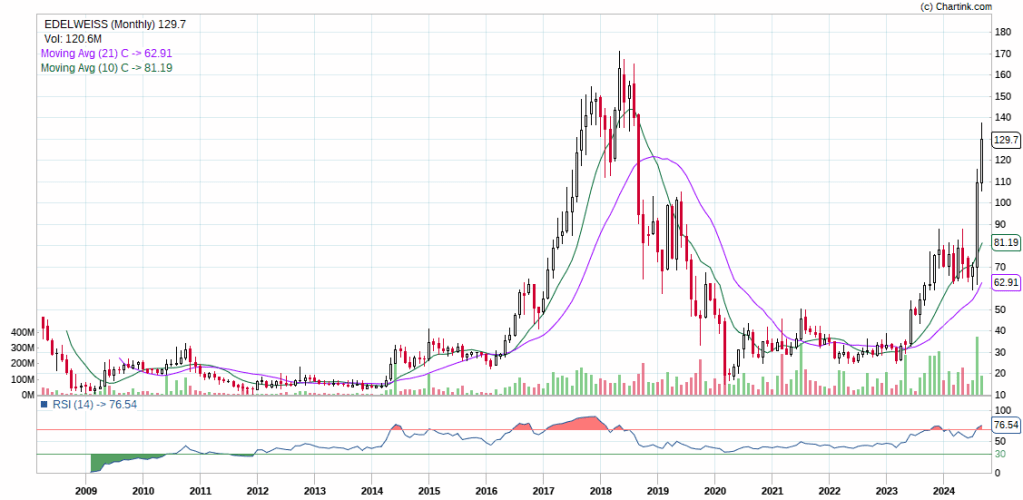
Moving averages are an essential technical indicator that smooths out price data to create a trend-following signal. For Edelweiss, the 10-day moving average (₹121.38) and 21-day moving average (₹114.64) represent the average closing prices over the last 10 and 21 trading days, respectively. As the current stock price of ₹130.1 is above both, it suggests upward momentum.
Volume Trends
With an average volume of 7.61 million shares, the increase in volume shows strong investor interest. High volumes paired with price gains usually indicate further upside potential.
RSI Levels
The Relative Strength Index (RSI), which measures the speed and change of price movements, is currently at 72.29. RSI levels above 70 are considered overbought, which could indicate a short-term correction. However, in a strong uptrend, an overbought RSI often suggests further bullish activity. Investors should monitor the RSI carefully to gauge potential pullbacks.
4. Fundamental Analysis
Debt-to-Equity Ratio and ROE Analysis
For potential investors, the debt-to-equity (D/E) ratio is a crucial metric. A D/E ratio of 2.11 suggests that Edelweiss has taken on significant leverage, which could increase risk, especially in times of financial downturn. However, it also indicates that the company is using debt to finance growth, which could lead to higher returns.
Return on Equity (ROE), currently at 7.2%, shows the company’s efficiency in generating profits from shareholders’ equity. While lower than some competitors, the figure suggests a stable return. Investors may want to compare this with industry peers to gauge how effectively the company uses its assets.
Market Cap, P/E Ratio, and Growth Comparison
| Company | Market Cap (₹ Cr) | P/E Ratio | Debt to Equity | Return on Equity (ROE) |
|---|---|---|---|---|
| Edelweiss | 13,500 | 17.5 | 2.11 | 7.2% |
| Motilal Oswal | 15,000 | 20.0 | 1.5 | 12.0% |
| IIFL Finance | 25,000 | 20.5 | 1.5 | 12.8% |
| JM Financial | 12,500 | 18.0 | 1.9 | 10.5% |
Revenue and Profit Growth (3-Year CAGR)
The Revenue and Profit Compound Annual Growth Rate (CAGR) is a key factor in assessing a company’s performance over time. Below is a visual comparison of Edelweiss and its competitors in terms of revenue growth:
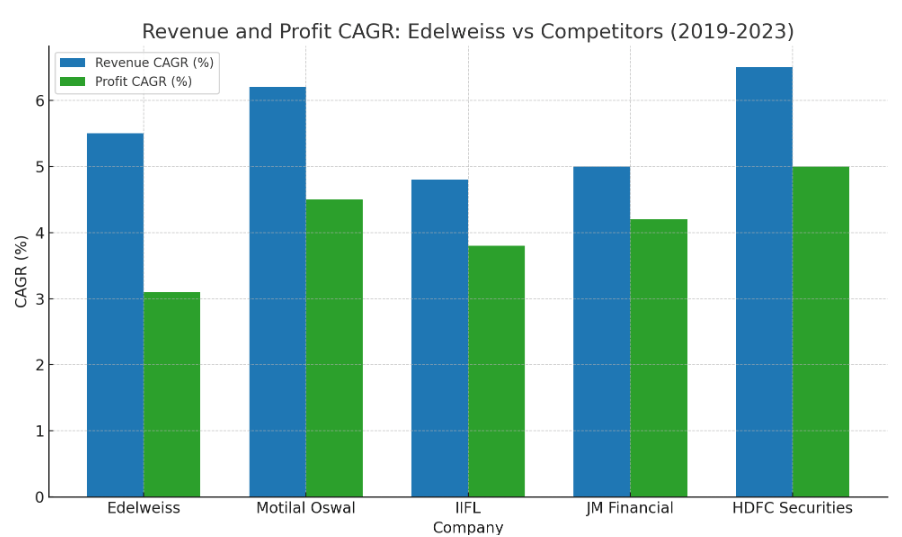
Here is the visual comparison chart of the Revenue and Profit Compound Annual Growth Rate (CAGR) for Edelweiss and its competitors (Motilal Oswal, IIFL, JM Financial, and HDFC Securities) from 2019 to 2023
5. Competitor Comparison
A detailed comparison of key financial metrics such as Market Cap, P/E Ratio, Debt-to-Equity, and ROE highlights how Edelweiss stacks up against its nearest competitors, including Motilal Oswal and IIFL Finance.
6. Price Target Projections
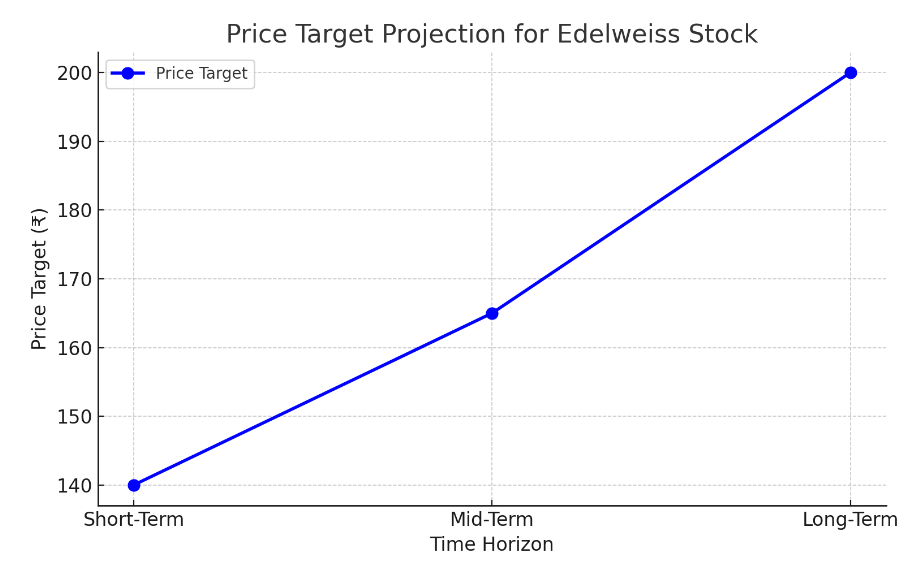
Here’s a projection for Edelweiss stock over different investment horizons:
| Time Horizon | Price Target (₹) |
|---|---|
| Short-Term | 140 |
| Mid-Term | 165 |
| Long-Term | 200 |
Below is a visual projection of Edelweiss’s price movement over time:
7. FAQ
Q1: Is Edelweiss a good buy now?
A stock can be considered a good buy if it shows favorable technical and fundamental indicators. For Edelweiss, while the stock is overbought in the short term, the long-term fundamentals, including growing revenue and a manageable debt-to-equity ratio, suggest that it could offer solid returns over time.
Q2: What are the risks in investing in Edelweiss?
The higher debt-to-equity ratio and relatively low ROE compared to competitors are areas of concern. If the financial sector faces a downturn, Edelweiss’s profitability may be affected.
Q3: What is the 1-year target for Edelweiss?
The mid-term (1-year) price target is projected to be ₹165, assuming favorable market conditions.
Q4: What is the target price for Edelweiss stock?
The long-term target price for Edelweiss stock is ₹200 based on technical and fundamental analysis.
Q5: What constitutes a good buy?
A good buy typically depends on a mix of factors, including a company’s financial health, growth potential, valuation metrics (like P/E ratio), and market conditions. In technical terms, a good buy can also be identified through indicators like moving averages and RSI levels. For fundamental investors, a good buy is often a stock that trades at a lower valuation compared to its intrinsic value and has strong growth potential.
8. Conclusion
In conclusion, Edelweiss presents a mix of opportunities and risks. While the stock shows strong short-term momentum with price action trending above key moving averages and favorable RSI, long-term investors should also consider the relatively high debt-to-equity ratio and lower ROE compared to competitors. Investors looking for a short-term gain could find opportunities, but caution is advised as the stock is in the overbought zone. Over the long term, Edelweiss remains a solid financial services player with steady growth potential.
For investors, the decision to invest should be based on individual risk tolerance, time horizon, and how the stock’s performance aligns with your overall portfolio strategy.
9. Disclaimer
This article is for educational purposes only. Stock market investments are subject to market risks, and investors should conduct their own research or consult with a financial advisor before making any investment decisions. The projections and targets mentioned in this article are not guaranteed outcomes and should not be considered financial advice.
 Market Sagas
Leave a comment